
Henry Bell
Henry Bell - A Famous Scottish Inventor & Pioneer of Steam Navigation
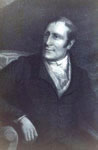 Henry Bell (1767 - 1830) is famous for the fact that he had the paddle steamer PS Comet built and used it in 1812 to start a passenger steamboat service on the River Clyde in Scotland, between Glasgow and Greenock. His venture became the first commercially successful passenger service in Europe.
Henry Bell (pictured left, click to enlarge) was born on the 7th April 1767 at Torphichen Mill, Linlithgow, his father being a millwright. After leaving school Bell began an apprenticeship as a mason. After studying to become a stonemason for 3 years Henry Bell decided to follow in his father's footsteps and was apprenticed to his uncle (who was also a mill-wright). It would appear that he lost interest, preferring engineering, as he then moved to Borrowstounness (or Bo'ness) to learn ship modeling, .After moving to Glasgow and onto London wherein he eventually became an apprentice of, the Scottish engineer, John Rennie.
In 1790 Bell, now 23, returned to Glasgow where he settled and started work as a carpenter. However his interests remained in engineering and started to experiment with the idea that ships could be propelled by steam. He corresponded with the American engineer Robert Fulton and in 1800 fitted a steam engine to a small vessel. That year, and again in 1803, he put his plans for steam propulsion of ships to the Admiralty, and although enthusiastically backed by Admiral Lord Nelson, they were rejected.
Henry Bell did not given up hope and started to visit the the boats built by William Symington. Bell was so interested in their design that he managed to become familiar with the patternmakers. With the launch of Symington's Charlotte Dundas, in 1803, steam power was proved to be sufficiently powerful to tow other vessels. Bell was able to study the "horizontal steam engine" in action and, after the Charlotte Dundas was left in a backwater (of the canal at Bainsford where it was eventually, broken up in 1861) he was able to study it in detail
By 1807 Robert Fulton had built the North River Steamboat and had used it to operate his commercial steamboat service in New York (the world's first).
In 1808 Henry Bell and his wife moved to Helensburgh where they invested in the purchase of the public baths and hotel. While Henry's wife became the superintendent of the baths Henry continued his studies with minor success. However, by 1811 he was able to get agreement with John Wood, a Port Glasgow shipbuilder, to commence work on building a 30 ton, 3 horse powered, steamboat which was to be called the Comet.
In 1812 the Comet made her maiden voyage and made the first commercial steamboat journey in Europe and continued to provide a regular service between Glasgow, Greenock and Helensburgh. Although Bell and his Comet had taken the lead it wasn't long before other businessmen saw the advantages and opportunities and Henry Bell was soon faced with competition. Shipbuilding was an expensive business and Bell could not compete with the newer, more powerful, vessels on the lucrative Firth of Clyde runs. Bell moved to the Forth of Forth and, after modifying the Comet (lengthened and re-engined), he offered a service which took four days to link Glasgow to Fort William via Oban and the Crinan Canal.
Sadly, in 1820 the Comet was shipwrecked in strong currents near Oban. The engine was salvaged, used in a brewery in Greenock, and is now on display in the Science Museum in London. Although Bell continued his interest in steamboats with the building of a second boat, also named the Comet, he failed to make it a commercial success.
Henry Bell build at second Comet but it did not prove a commercial success.
In 1830 Henry Bell died in Helensburgh where he is remembered by a monument on the sea front.
You can view a replica of the original Comet in the centre of Port Glasgow.
Back to