
John Logie Baird
John Logie Baird - A Famous Scottish Inventor
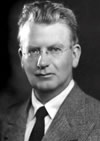 John Logie Baird (1888 - 1946) was trained as a motor mechanic and later became an electrician in a power station. He was of an inventive turn of mind and took an interest in any problem that came his way. While at the power station he attempted to make diamonds, his process requiring the sudden discharge of a powerful electric current. He utilised the facilities at hand and inadvertently plubged the town into sudden darkness. Being afraid to acknowledge ownership of the fragments of his apparatus, he never discovered if he had been successful.
He then invented a sock with a special thick sole for walking. He had several pairs made and sold them door to door, but without financial success. His next enterprise - jam making in the West Indies - also failed, so he returned to England in poor health and was advised to lead a quiet life by the sea. He took lodgings at Hastings, and to occupy his time he turned his mind to television.
His first apparatus was made of an old tea-chest, a biscuit-tin, a bull's-eye lense and a toy electric motor. He later added several more lenses and fitted them to a "Nipkow disc", a device invented by P. Nipkow in 1884 for scanning a picture in narrow parallel lines. His receiving apparatus contained a similar disc, and Baird's chief original contribution to television was his ingenious method of synchronising the revolutions of the two discs. He successfully transmitted (through short wires) a black-and-white drawing of a Maltese cross in 1923, and in 1925 televised a ventriloquist's dummy. He then sought financial backing and the Baird Television Company was formed.
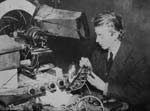 John Logie Baird giving his first public demonstration of television, 1926 (click to enlarge). |
A demonstration of Baird's television was given at the Royal Institution in 1926, and in 1927 images were transmitted by telephone wires between London and Glasgow. The BBC was interested and lent facilities for experimentation, and in 1928 the faces of people being interviewed in a London studio were successfully recieved by wireless in New York. In 1928 Baird also applied his system satisfactorily to colour television, and made the further step of transmitting daylight pictures instead of relying on studio light.
The Baird system could not produce pictures larger than 4 inches by 2 inches until 1932 when the size was increased to 9 inches by 4 inches, though it was not practicable to use more than 30 scanning lines. In that year the BBC began regular television broadcasts from Broadcasting House, and these continued until 1935. Meanwhile, Baird turned his attention to "noctovision", an adaption of television in which objects in complete darkness were "viewed" by their infra-red rays and transmitted to an ordinary receiver, which showed them as visible pictures.
The chief drawback of the Baird television system was that it had mechanically moving parts, and these could not be mad large enough to give a big picture of high definition except in very cumbersome apparatus. It was therefore replaced by the cathode-ray system, first proposed by Campbell Swinton in 1908. Nevertheless, Baird was the first inventor of a practicable system, and his success was due largely to his dogged perseverance and persistance, in both the experimental and commercial stages of his venture.
Back to