
Haggis
Scottish Recipe 004 - Haggis
Haggis is extremely well known and, perhaps, the one food which most represents Scotland. Haggis is a traditional Scottish dish made from sheep's heart, liver and lungs finely chopped and mixed withoatmeal, suet, onion, spices and salt. Traditionally the Scottish haggis is cooked in a sheeps stomach, rather like a very large oval sausage.
The haggis is very well-known internationally as it is traditionally served with the Burns supper (January 25th) and St. Andrews Night meals. It was the subject of the Robbie Burn's poem, "Address To A Haggis" and the "Address to a Haggis" is one of the highlights of any Burns supper.
The haggis is also very well known to the children of the world as it is often brought to life in cartoon form. As an object of fun the haggis is usually portayed as a little animal with one set of legs longer than the other and, more often than not, pictured playing the bagpipes.
 One of the most common questions asked of the haggis is "what are the contents of a haggis". Most wait in eagerness to be horrified by the ingredients of a haggis but the truth is often a let down for them. Until the 18th century it was eaten in England and most countries have something similar. Norway has something very close to the haggiswhich is vegetarian made from beans and lentils. However the haggis will always remain something of a mystery.
Today it is far more common for people to buy there haggis from a local butcher or mail order company. Making a haggis is an art and there are a few things that can go wrong so it is better to be safe than sorry. You will also benefit from the butchers expertise and many are competition winners!
Haggis is traditionally served with "neeps and tatties" (yellow turnip/swede and potatoes).
Recipe for Haggis (1)
Haggis Ingredients
| Imperial | Metric | American | |
| Stomach bag of sheep | 1 | 1 | 1 |
| Sheep's liver | 4 oz | 100 g | ¼ lb |
| Sheep's heart | 1 | 1 | 1 |
| Onions | 2 | 2 | 2 |
| Beef suet | 2 oz | 50 g | 4 tbsp |
| Salt and black pepper | |||
| Toasted oatmeal | 3 oz | 75g | 1 cup |
| Gravy from liver | ½ pint | 250 ml | 1 ¼ cups |
Method:
Wash the stomach bag thoroughly, first in cold water, then, scraping, in hot water. Leave to lie overnight in a bowl of cold salted water. Wash again carefully and place in a pan of boiling water to cover, with the windpipe hanging over the side. Add 1 tsp salt and boil for 2 hours. Remove from pan and cut away the windpipe and any gristle.
Clean the liver and heart, washing well, and boil wish the onions for about 30 minutes or until tender. When cool, mince the meat and chop the onions. Grate the suet and mix with the meat, onion and seasoning. Add, the oatmeal and enough liquor from the meat to make a soft, droppable consistency.
Fill the bag, just over half full, leaving space for the mixture to expand. Sew up the hole with strong thread and cook haggis in a large pan of boiling water for 3 hours. Prick occasionally with a skewer to prevent it from bursting.
Should the haggis be made some time before it is wanted, reheat in boiling water, boiling without the lid for 1 1/2 hours.
Note:
There is many a legend connected with the origin and ingredients of the haggis. However, it is - and always will be - Scotland's greatest national dish, piped in with great ceremony at Burns suppers everywhere. It is served with neeps and tatties (turnips and potatoes) and washed down with nips of whisky.
Pan Haggis
Prepare the same ingredients as for the standard sheep's haggis. However, instead of cooking it inside the stomach bag, stew in a covered saucepan for 2 hours, adding more gravy or strong brown stock.
Recipe for Haggis (2)
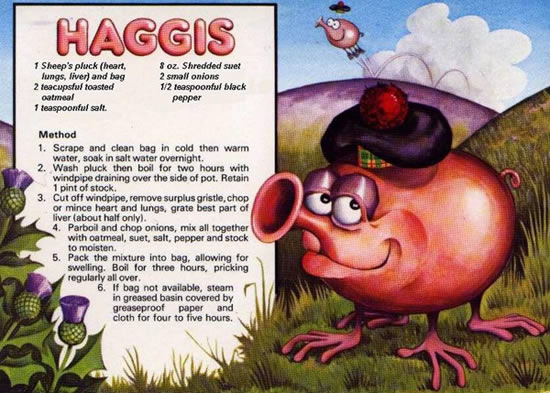
Haggis recipe with a comic haggis looking on
If you stumbled onto this page looking for the band "Enter The Haggis" you will find their official website over at
www.enterthehaggis.com
Haggis Books:
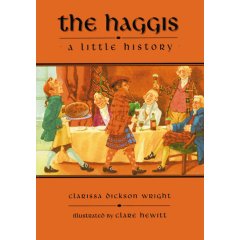 The Haggis A Little History
 by Clarissa Dickson Wright (Author), Clare Hewitt (Illustrator) is an amusing and informative little book all about the history of the haggis.
Some interesting facts are brought to light - such as the fact that the haggis was known to the Ancient Greeks! Well, maybe not the true Scottish haggis but an ancient version of it.
The life of the haggis is examined from it's lowly roots as a meal for the lower classes up to the highest of all in Queen Victoria of England who loved all things Scottish and regularly indulged in a little haggis.
You can purchase this book from Amazon.com
Well worth the money and a worhy addition to any library.
We will try to find other books about the haggis that we consider a useful book to have so pleas call back soon.
Back to
Scottish Recipes